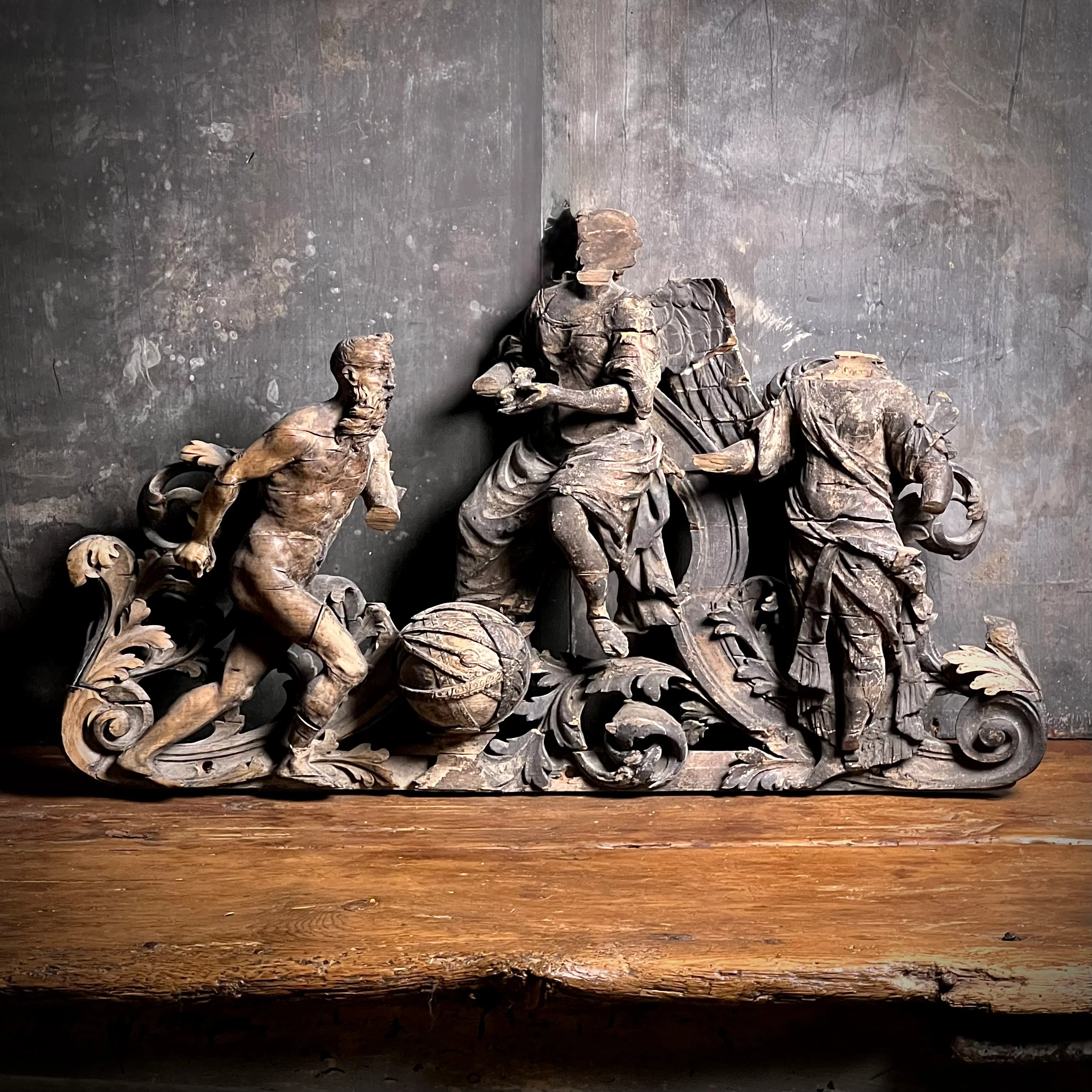
Baroque Limewood Relief with Angel, Lamb and Allegorical Figures, c.1650–1720
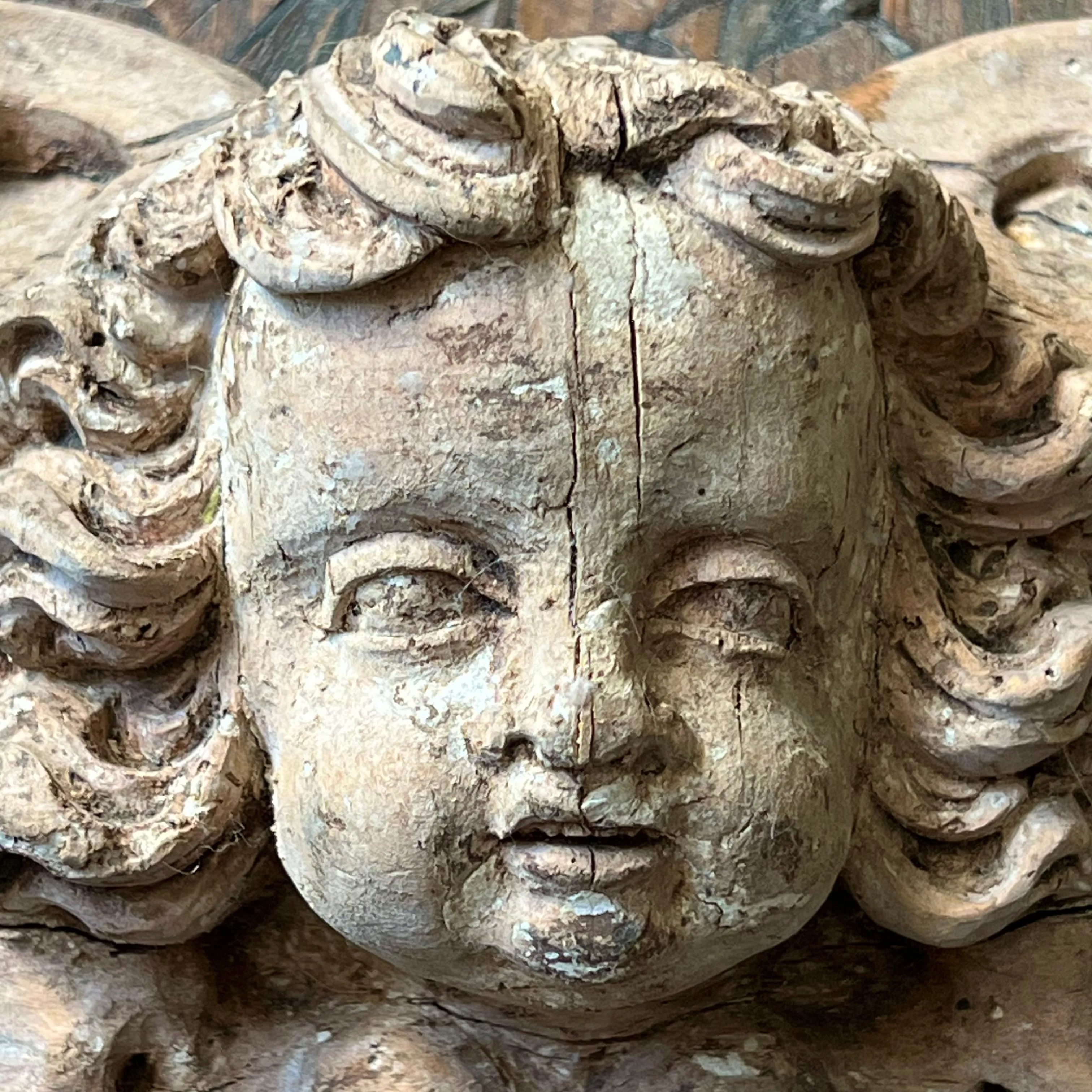
A beautifully carved Baroque limewood relief from the mid-17th to early-18th century, almost certainly from the Alpine regions of Southern Germany or the Austrian Tyrol.
The composition centres on a winged angel presenting the Lamb of God, flanked by two contrasting allegorical figures. One is a wonderfully life-like, dynamic, semi-nude male embodying humanity or nature in its raw, earthly state; the other a robed figure suggesting Law, Virtue or Prophecy. Between them is an armillary sphere — a Renaissance symbol of the ordered cosmos — the composition is woven into a Baroque meditation on salvation and divine order.
Carved in limewood with deep movement, expressive modelling and bold acanthus scrollwork, the relief would originally have formed part of a larger ecclesiastical ensemble such as a frieze above a doorway, pulpit or altarpiece. Its theatrical energy and unusual iconographic combination give it a striking presence and a rare intellectual depth.
Wear consistent with age.
Product Information
Product Information
Shipping & Returns
Shipping & Returns
Description
A beautifully carved Baroque limewood relief from the mid-17th to early-18th century, almost certainly from the Alpine regions of Southern Germany or the Austrian Tyrol.
The composition centres on a winged angel presenting the Lamb of God, flanked by two contrasting allegorical figures. One is a wonderfully life-like, dynamic, semi-nude male embodying humanity or nature in its raw, earthly state; the other a robed figure suggesting Law, Virtue or Prophecy. Between them is an armillary sphere — a Renaissance symbol of the ordered cosmos — the composition is woven into a Baroque meditation on salvation and divine order.
Carved in limewood with deep movement, expressive modelling and bold acanthus scrollwork, the relief would originally have formed part of a larger ecclesiastical ensemble such as a frieze above a doorway, pulpit or altarpiece. Its theatrical energy and unusual iconographic combination give it a striking presence and a rare intellectual depth.
Wear consistent with age.